
13 Practical Energy Saving Tips for Hazara Households to Lower HAZECO Bills
Electricity tariffs in Pakistan are at an all-time high, managing the monthly HAZECO bill has become a top household priority. Whether you live in the sweltering heat of Haripur or the chilling cold of Abbottabad, high energy bills are a shared burden.
Many people believe that lowering the bill requires expensive solar systems or living in the dark. That is not true. By understanding how HAZECO calculates your bill and adjusting your daily habits, you can significantly reduce your units.
Before diving into saving tips, take a moment to understand what you are actually paying for. Your HAZECO bill is made up of several components: Units Consumed (kWh), Tariff Slabs, Fuel Price Adjustment (FPA), Fixed Charges, taxes, and service charges. Knowing which component is driving your bill makes it much easier to target your savings. For a quick walkthrough of your bill, you can View Your HAZECO Bill Online here.
Here is a practical, localized guide to cutting down your electricity bill in 2026.
Know Your Meter: Do You Pay “Peak Rates”?
Before you start saving, you must know how you are charged. There is a common misconception that everyone pays more at night (Peak Hours). This depends entirely on your meter type:
1. The Single Phase Meter (Load under 5kW)
Most domestic households in Hazara fall under Tariff A-1.
- How you are charged: You pay based on Slabs (Total Monthly Units).
- The Reality: Running an AC at 8:00 PM costs the same as running it at 8:00 AM.
- Your Goal: Slab Management. Your mission is to keep monthly consumption low enough to remain eligible for protected tariff rates, where applicable or at least stay under 300 units. Crossing these limits drastically increases the rate of every single unit on your bill.
2. The 3-Phase / TOU Meter (Load above 5kW)
If you have a large house with a digital 3-phase meter, you are likely on Tariff A-1b (Time of Use).
- How you are charged: You have two rates: Peak and Off-Peak.
- The Reality: Electricity is significantly more expensive (approx. Rs. 49-55/unit) during Peak Hours (typically 5 PM to 11 PM) compared to Off-Peak hours (Rs. 38-42/unit).
- Your Goal: Shift all heavy usage (ACs, Iron, Water Pump) to Off-Peak hours.
Note: Actual savings depend on usage pattern and applicable tariff category.
Pro Tip for Everyone: Even if you have a Single Phase meter, avoid running heavy appliances during evening hours (6 PM – 10 PM). Why? Because voltage in Hazara often drops during these hours. Low voltage causes motors (fridges, fans) to heat up and draw more current, indirectly increasing your consumption and risking damage to appliances.
This advice is for appliance efficiency and voltage stability only; single-phase domestic consumers are not charged separate peak rates
13 Practical Ways to Lower Your HAZECO Bill
1. The “Slab Management” Strategy
For most families, the difference between a Rs. 3,000 bill and a Rs. 8,000 bill is often just 10 units.
- The Habit: Check your meter reading around the 20th day of your specific billing cycle (refer to the “Reading Date” on your previous bill). If you have consumed around 135 to 140 units, you are in the danger zone. This leaves you with roughly 60 units for the remaining 10 days (an average of 6 units per day). Strictly minimizing usage now can help you stay under the 200-unit limit to retain your subsidized rates.
- You can use the HAZECO Bill Calculator to model how changing your consumption by even 10–20 units affects your final bill amount. it is a powerful tool to use before your billing cycle ends.
- For Large Families: For properties with multiple portions or separate households, consumers may explore obtaining separate legally approved electricity connections for each portion, subject to HAZECO rules and inspection. Separate connections are billed independently and may result in different billing outcomes depending on consumption.
2. The AC Strategy: 26°C + Efficient Fan (For Haripur & Havelian)
- In the hot belts of Hazara, ACs are the biggest expense. Setting your AC to 18°C doesn’t cool the room faster; it just forces the compressor to run non-stop.
- The Fix: Set the AC to 26°C and run a ceiling fan on low speed. The fan circulates the cool air, making 26°C feel like 22°C, while the AC compressor takes frequent breaks, saving up to 25% electricity.
- Remember: each degree higher on the thermostat saves approximately 4–6% in energy, so even moving from 22°C to 26°C makes a significant difference.
- The Upgrade: To maximize savings, swap your old ceiling fan for a modern AC/DC Inverter Fan. An old fan consumes 80-100 watts, whereas a new Inverter Fan consumes only 30-50 watts at full speed. Running an efficient fan with your AC at 26°C is the ultimate cooling hack for Hazara summers.
- Government Support: The Government of Pakistan has launched the Prime Minister’s Fan Replacement Program 2025. You can replace your old, inefficient fans with new 5-Star rated energy-saving fans on easy monthly installments added directly to your electricity bill. Visit this page or contact your nearest HAZECO subdivision office to apply.

3. Winter Heating: Insulate First (For Abbottabad & Mansehra)
In the upper Hazara region, winter bills are higher than summer bills due to electric heating. The common “Rod Heater” (Blower) is an energy disaster, consuming 1000-1500 watts continuously.
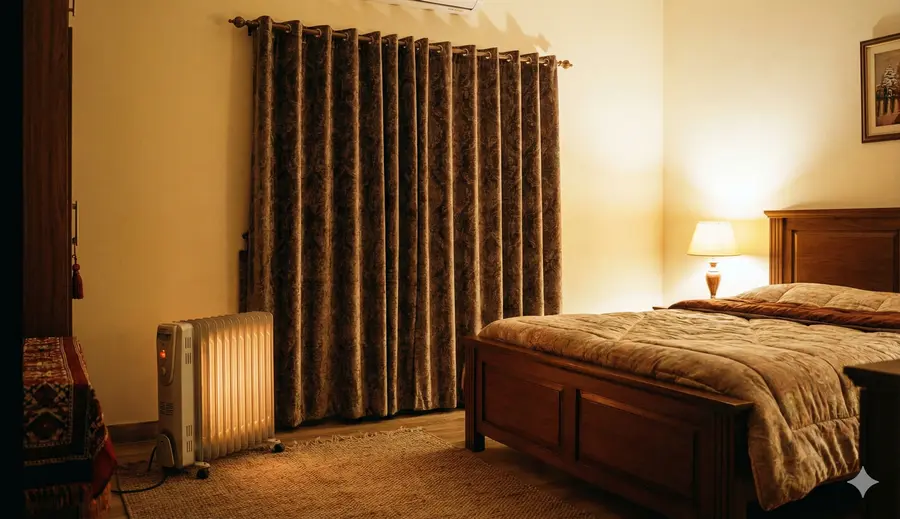
- The Fix: Focus on retaining heat. Use heavy curtains, seal gaps under doors with draft stoppers, and lay carpets. If you must use electric heat, an Oil-Filled Radiator is more efficient than a rod heater because it retains heat long after being turned off.
- Adding reflective material on rooftops and rugs on floors can significantly reduce heat loss.
4. The Geyser Timer Rule
Leaving an electric geyser on 24/7 is like keeping a kettle boiling all day. It is the silent killer of winter bills.
- The Fix: Turn the geyser on only 1 hour before you need it (e.g., in the morning) and turn it off immediately after.
- Where possible, consider switching to an instant water heater. It heats water on demand and eliminates the standby energy loss of a storage geyser entirely.
- Thermostat: Lower the thermostat setting from “Hot” to “Warm.” You mix cold water for bathing anyway, so why pay to overheat the water just to cool it down again?
5. Replace Old “Energy Savers” with LED Bulbs
If you still use spiral “Energy Savers” (CFLs) or old glass bulbs, throw them away.
- The Math: A 24-watt Energy Saver gives the same light as a 12-watt LED. By replacing just 5 bulbs, you save 60 watts per hour. Over a year, this small change saves thousands of rupees.
- Bonus Habit: During the day, prioritize natural sunlight. Open curtains and avoid turning on artificial lighting until it is truly necessary. It costs nothing and keeps the room cooler too.
6. Unplug “Vampire” Electronics
Appliances like TVs, microwaves, and UPS inverters consume power even when they are “off” but plugged in. This is called Phantom Load.
Chargers, set-top boxes, routers, and UPS units are the most common silent consumers in Pakistani homes. This habit alone can save approximately 5–8% on your monthly bill. Use a switched power strip so you can cut power to multiple idle devices at once.
- The Habit: Switch off the TV from the main switchboard, not just the remote. Unplug phone chargers when not in use.
7. Efficient Ironing: Bulk Batches
An electric iron (istri) consumes 1000 watts. The iron uses the most energy heating up from cold to hot.
- The Habit: Don’t iron one suit every morning. Iron a week’s clothes in one session on the weekend. This utilizes the accumulated heat efficiently.
- If you have a 3-Phase meter, schedule this ironing session during Off-Peak hours for maximum savings.
8. Refrigerator Airflow & Seals
Your fridge works by pushing heat out of the box. If it is pushed tight against a wall, it has to work double-time.
- The Fix: Pull the fridge 6 inches away from the wall. Also, test the door seal: close the door on a piece of paper. If you can pull the paper out easily, cold air is escaping, and you need to replace the rubber gasket.
- Periodically defrost and clean fridge coils as well. A dirty coil makes the compressor work harder and draws more electricity over time.
9. Use “Cross Ventilation” (The Galyat Advantage)
Residents of Abbottabad and the Galyat have a natural advantage: cool evening breezes.
- The Habit: Instead of turning on a fan or AC instantly, open windows on opposite sides of the house in the evening. This “Cross Ventilation” pushes hot air out and cools your home naturally for free.
10. Service Your Appliances
A dusty fan runs slower but consumes more power. A dirty AC filter blocks airflow, forcing the unit to run longer.
- The Habit: Clean AC filters every 2 weeks in summer. Clean ceiling fan blades at the start of the season.
- For solar panel owners, regular panel cleaning keeps output at its peak. Dust and bird droppings can reduce output significantly. Also, trim any tree branches that cast shadows on your panels during the day, as even partial shading can noticeably reduce the overall output of your solar system.
11. Optimize Your Water Pump Use
Water pump motors are often overlooked but are high wattage devices. A standard 1HP motor consumes approximately 1 kWh per hour of runtime. Run pumps only when needed, fix household water leaks to avoid repeated pump cycles, and consider upgrading to a more efficient motor if yours is old. If you have a 3-Phase meter, scheduling pump use during Off-Peak hours is an easy win.
12. Monitor Your Usage with Tools
You cannot manage what you do not measure. Use the HAZECO Load Calculator to understand which appliances in your home are consuming the most units. Keeping a rough daily log of your meter reading, even just once a week, helps you spot unusual spikes before the billing cycle ends.
13. Make It a Household Effort
All the tips above work best when every family member is on board. Train children to turn off lights when leaving a room. Make sure everyone knows the household daily unit target. Collective behavioral change alone can cut 15 to 20% from monthly bills without any investment.
Investing in the Future: Inverters & Solar
If you have the budget for upgrades, stop buying standard appliances.
- Inverter ACs & Fridges: These are essential for Hazara’s voltage fluctuations. They start on low voltage and reduce electricity consumption by 40-60% once the desired temperature is reached.
- Inverter refrigerators also offer 20 to 35% savings compared to conventional models, making them a worthwhile upgrade for any household.
- Solar: Even a small 3kW solar system can offset your heavy daytime usage (Water motor, Ironing, Washing Machine), keeping you in the lower billing slabs.
- If you generate excess electricity, net metering allows you to send it back to the grid and further reduce your monthly bill.
Conclusion
Lowering your HAZECO bill doesn’t require a miracle; it requires mindfulness. Whether it is turning off the geyser in Mansehra or setting the AC to 26°C in Haripur, these small habits compound over 30 days to keep your bill manageable.
Want to check if your savings strategy worked? Click here to check your latest HAZECO Bill Online