
How to Read & Understand Your HAZECO Electricity Bill
An electricity bill is more than just a payable amount. If you carefully understand each section of your Hazara Electric Supply Company (HAZECO) bill, you can identify how your bill is calculated, why it increases, and whether the charges applied are correct.
This guide explains each and every part of a real HAZECO electricity bill, including new features like QR code payments, two due dates, and government advertisements, using an actual bill format.
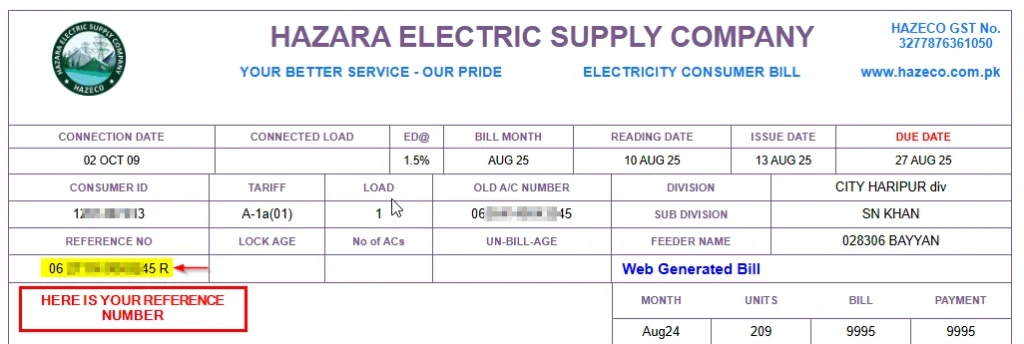
Billing structure, taxes, and calculations explained here are standard across all DISCOs in Pakistan (LESCO, FESCO, IESCO, GEPCO, etc.).
Why Understanding Your HAZECO Bill Is Important
Many consumers only look at the total payable amount and ignore the breakdown. This can lead to confusion about:
- Sudden bill increases
- Higher taxes
- Fuel price adjustments
- Loss of protected consumer status
By understanding your bill:
- You can verify charges
- Identify billing errors
- Reduce unnecessary electricity usage
- Plan your monthly budget better
Main Sections of a HAZECO Electricity Bill
A typical HAZECO bill is divided into different sections:
- Consumer & Connection Information
- Electricity Units & Tariff
- Charges & Adjustments
- Taxes & Duties
Let’s explain each one step by step.
1. Consumer & Connection Information (Top Box)
This block defines who you are and what type of connection you have.
Includes:
- Consumer ID (10 digits)
- Reference Number (14 digits)
- Tariff Code (e.g. A-1a Domestic)
- Sanctioned Load (kW)
- Old Account Number (if any)
- Lock Age / Un-bill Age / No. of ACs (internal system info)
The reference number is required for:
- Online bill checking
- Online payment
- Complaints & tracking
2. Area & Network Information
Immediately after consumer info, the bill shows:
- Division
- Sub-Division
- City
- Feeder Name & Feeder Code
Why this matters:
- Load-shedding is feeder-based
- Complaints are handled by subdivision
- Faults & outages depend on feeder condition
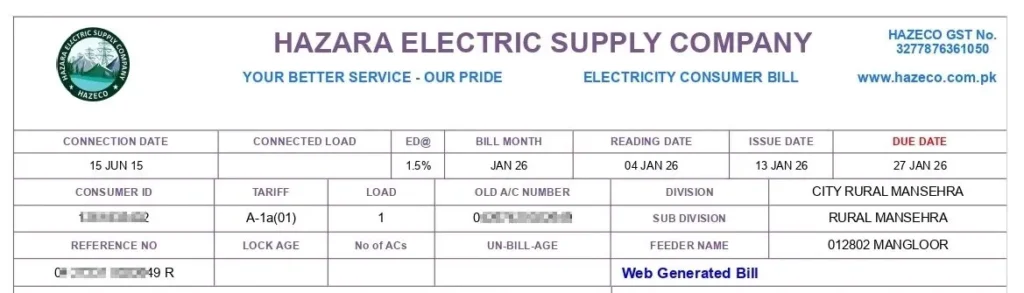
3. Billing Dates & Meter Timeline
This row shows all important dates:
- Connection Date
- Bill Month
- Meter Reading Date
- Bill Issue Date
- Due Date
These dates determine:
- Late payment surcharge
- Whether the bill is delayed
- Complaint eligibility
4. Name & Address Section
This section confirms billing ownership.
Includes:
- Consumer Name
- Father / Husband Name
- Complete Address (Village / Mohallah / City)
If this information is incorrect, correction must be requested from your relevant sub-division office.

5. Monthly Consumption History (Units & Bills Table)
You’ll see a table showing:
- Previous months
- Units consumed
- Bill amount
- Payment status
This helps you:
- Verify protected consumer eligibility by checking if units stayed within 200 for the last 6 months
- Compare seasonal usage (summer vs winter consumption)
- Detect abnormal or sudden spikes that may affect subsidy status
- Track monthly consumption trends to avoid crossing slab limits
- Plan usage in advance to stay in the protected category
6. Meter Reading Details
This section explains how units are calculated.
Fields include:
- Meter Number
- Previous Reading
- Present Reading
- MF (Multiplier Factor)
- Units Consumed
- Meter Status
Formula used:
(Current Reading − Previous Reading) × MF = Units
Pro Rata Billing at HAZECO
Pro Rata Billing at Hazara Electric Supply Company (HAZECO) ensures that your electricity bill accurately reflects the actual number of days your meter was read, rather than a fixed monthly period. This adjustment is typically applied when the billing period exceeds 30 days, such as in cases of delayed meter readings or extended billing cycles.
How Pro Rata Billing Works
Example 1: Billing for More Than 30 Days
- Scenario: Your meter was read over 33 days, but the standard billing cycle is 30 days.
- Calculation:
- Actual Units Consumed: 210 kWh
- Adjusted Units: 210 ÷ 33 × 30 = 190.91 kWh
- Units Billed: 191 kWh (rounded)
This adjustment ensures that your bill reflects the actual usage over the standard billing period, preventing overcharging.
Example 2: Billing for Less Than 30 Days
- Scenario: Your meter was read over 27 days, but the standard billing cycle is 30 days.
- Calculation:
- Actual Units Consumed: 180 kWh
- Adjusted Units: 180 ÷ 27 × 30 = 200 kWh
- Units Billed: 200 kWh
This adjustment ensures that your bill reflects the actual usage over the standard billing period, preventing undercharging.
Automated & Transparent Adjustments
HAZECO applies Pro Rata adjustments automatically when the billing period deviates from the standard 30 days. If your bill includes a Pro Rata adjustment, it will typically be noted as:
“Billing for more than 30 days (pro-rata)”
This notation indicates that the billed units have been adjusted to align with the standard billing period.
Pro Rata Billing at HAZECO ensures that your electricity bill accurately reflects your actual usage over the standard billing period, preventing overcharging or undercharging due to variations in the meter reading cycle. If you notice a Pro Rata adjustment on your bill, it’s a standard practice to align your charges with the actual number of days your meter was read.
7. HAZECO Charges Section
This is where electricity cost is built.
Common fields:
- Units Consumed
- Cost of Electricity
- Fixed Charges
- Fuel Price Adjustment (FPA)
- Quarterly Tariff Adjustment (QTA / DMC)
- FC Surcharge
These charges are approved by NEPRA and applied nationwide.
What is Fuel Price Adjustment (FPA) Your HAZECO Electricity Bill?
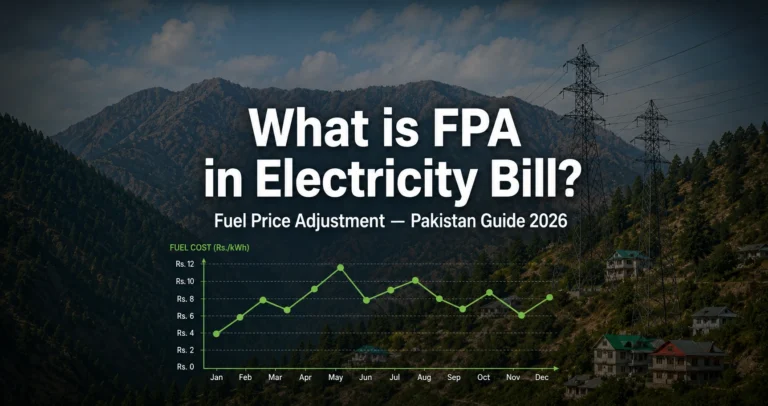
FPA stands for Fuel Price Adjustment, a monthly charge or credit that appears separately on your electricity bill. Pakistan generates electricity using various fuels like natural gas, furnace oil, coal, and LNG. Since the cost of these fuels fluctuates every month, NEPRA (National Electric Power Regulatory Authority) adjusts your bill accordingly. If fuel was more expensive than expected, your bill goes up. If cheaper, it comes down.
NEPRA announces a new FPA rate every month after reviewing actual fuel cost data. This rate then appears in your bill approximately two months later. So the FPA you see in your current bill is not for this month instead it is for electricity you consumed two months ago. For example, if your April 2026 bill shows FPA FEB-26 @ 1.4235, it means NEPRA set Rs. 1.4235 per unit as the fuel cost difference for February 2026, and it is now being charged in your April bill.
The calculation is simple: Units consumed in that month × FPA rate = FPA amount. If you consumed 119 units in February 2026, your FPA charge would be 119 × 1.4235 = Rs. 169.40. This amount is added to your current bill. Note that FPA can also be negative meaning it reduces your bill when actual fuel costs were lower than NEPRA’s reference price.
What are Fixed Charges in Your HAZECO Bill
As per S.R.O. 279(I)/2026, effective 12th February 2026, NEPRA has fundamentally restructured how fixed charges are calculated for electricity consumers. The key change: fixed charges have been converted from a flat Rs./Consumer/Month rate to Rs./kW/Month, meaning they are now directly tied to your Sanctioned Load (kW) or Maximum Demand Indicator (MDI). The more load you have sanctioned regardless of how many units you actually consume the more you pay in fixed charges every month.
This change applies to residential fixed charges only. Fixed charges for other categories (Commercial, Industrial, Agricultural, etc.) remain as per the previously notified tariff schedule. No change applies to Residential Lifeline consumers.
1. Regular (Non-ToU) Residential Consumers — Tariff A1
For standard domestic connections, your fixed monthly charge is now calculated by multiplying your Sanctioned Load (kW) by the fixed charge rate applicable to your monthly consumption slab.
The Formula:
Sanctioned Load (kW) × Applicable Fixed Charge Rate (Rs./kW/month) = Total Fixed Charge
Here is the complete updated tariff schedule for Residential A1 consumers:The applicable rate depends on your consumption slab and whether you fall under the Protected or Unprotected category:
| Category | Consumption Slab | Fixed Charge Rate (Rs./kW/month) |
| Protected | Up to 50 Units (Lifeline) | 0 |
| Protected | 51–100 Units (Lifeline) | 0 |
| Protected | 1–100 Units | 200 |
| Protected | 101–200 Units | 300 |
| Unprotected | 1–100 Units | 275 |
| Unprotected | 101–200 Units | 300 |
| Unprotected | 201–300 Units | 350 |
| Unprotected | 301–400 Units | 400 |
| Unprotected | 401–500 Units | 500 |
| Unprotected | 501–600 Units | 675 |
| Unprotected | 601–700 Units | 675 |
| Unprotected | Above 700 Units | 675 |
Note: Lifeline consumers (up to 50 units/month) have zero fixed charges and pay only Rs. 3.95/kWh in variable charges.
Example A — Protected Consumer (100 units, 2 kW load): You consumed exactly 100 units, placing you in the protected slab at Rs. 200/kW. Your sanctioned load is 2 kW.
2 kW × Rs. 200 = Rs. 400 Fixed Charge
Example B — Unprotected Consumer (100 units, 2 kW load): You consumed 100 units but are classified as unprotected, where the rate is Rs. 275/kW. Your sanctioned load is 2 kW.
2 kW × Rs. 275 = Rs. 550 Fixed Charge
Example C — Unprotected Consumer (132 units, 2 kW load): You consumed 132 units, placing you in the 101–200 unprotected slab at Rs. 300/kW. Your sanctioned load is 2 kW.
2 kW × Rs. 300 = Rs. 600 Fixed Charge
Notice the difference: a Protected and Unprotected consumer consuming the same 100 units pay Rs. 400 vs Rs. 550 respectively — a Rs. 150 difference — purely because of their protection status, not their consumption.
2. Time of Use (ToU) Residential Consumers
For consumers with a peak load requirement exceeding 5 kW who are billed on Peak and Off-Peak rates, the fixed charge rate is Rs. 675/kW/month. However, the kW figure used is not simply your full sanctioned load — it is based on your actual recorded demand.
The Formula:
Higher of (50% of Sanctioned Load OR Actual MDI) × Rs. 675 = Total Fixed Charge
The MDI (Maximum Demand Indicator) is the highest level of power demand your meter recorded at any single point during the billing month. This protects consumers from being billed on their full sanctioned load when their actual usage was lower — but ensures a minimum floor of 50% of sanctioned load.
ToU Example:
- Sanctioned Load = 6 kW
- 50% of Sanctioned Load = 3 kW
- MDI recorded this month = 4 kW
- Since MDI (4 kW) > 50% of sanctioned load (3 kW), the bill uses 4 kW
4 kW × Rs. 675 = Rs. 2,700 Fixed Charge
3. What Has NOT Changed
It is equally important to know what this SRO did not change:
- Lifeline consumers (up to 50 units/month) — no fixed charges, unchanged.
- Commercial, Industrial, Agricultural consumer fixed charges — remain on the old Rs./Consumer/Month structure as per the previously notified schedule.
- Variable (per unit) charges — these have also been revised under SRO 279 alongside the fixed charge restructuring (see the variable charges column in the table above).
Pro-Tip: Check and Reduce Your Sanctioned Load
Since fixed charges are now directly multiplied by your sanctioned load, this one number can silently inflate your bill every month — even in months where you barely use electricity.
Here’s what to do:
- Find the “Sanctioned Load (kW)” field printed at the top of your HAZECO bill.
- Add up the actual wattage of appliances you regularly use and convert to kW.
- If your sanctioned load is significantly higher than your actual need, apply to your DISCO to revise it downward.
Even reducing your sanctioned load by 1–2 kW can save you hundreds of rupees per month in fixed charges permanently, on every future bill.
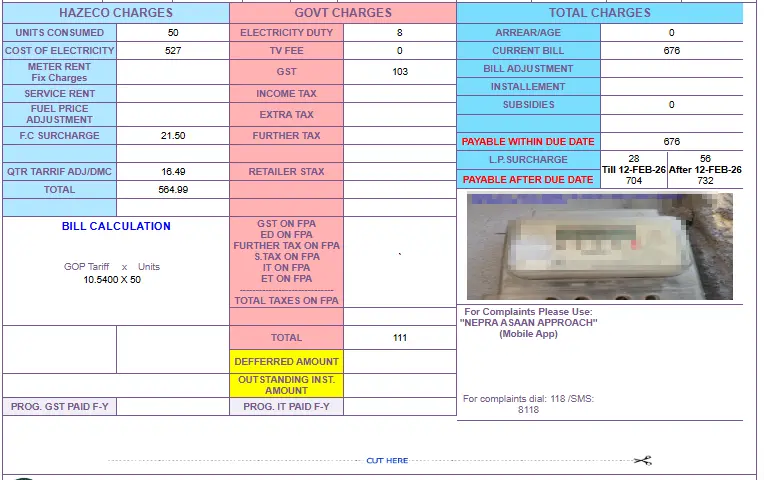
8. Government Charges & Taxes Section
This section lists government-imposed taxes.
Some may be zero on your bill, but they legally exist and may apply later.
Taxes Explained:
| Tax | How It Is Calculated |
| Electricity Duty (ED) | % of energy charges |
| GST | % of bill amount |
| Income Tax | Mostly commercial / high usage |
| Extra Tax | Specific cases |
| Further Tax | Certain consumer categories |
| Retailer Tax | Business connections |
HAZECO only collects these taxes. it does not keep them.
9. PTV Fee (Field Exists but Amount Removed)
The PTV Fee field still appears, but:
PTV Fee has been removed, and the amount is zero.
10. Bill Calculation Box
This box shows the exact energy calculation.
Example:
GoP Tariff × Units
10.54 × 74
This is the base electricity cost, before taxes and adjustments.
Note: 10.54 Rs./kWh is the variable charge rate for Protected consumers (1–100 units). Fixed charges are calculated separately based on sanctioned load as explained above.
11. Total Charges Summary
This block combines everything:
- Current Bill
- Arrears (if any)
- Installments
- Subsidies (if applicable)
Result:
Payable Amount
12. Two Due Dates System (New Feature)
HAZECO bills now show two payment stages:
Payable Within Due Date
- Normal amount
- No penalty
Payable After Due Date
- Late Payment Surcharge (LPS) added
- Two levels:
- Till a specified date
- After final cut-off date
Always pay before the first due date.
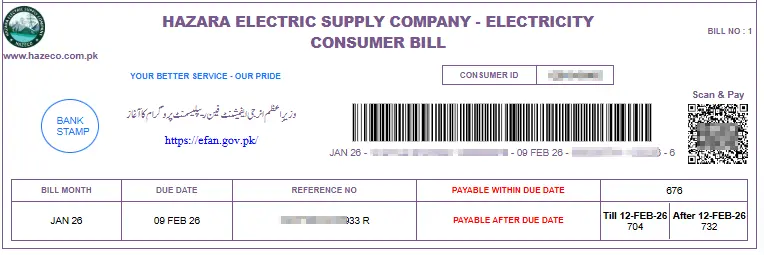
13. QR Code – Scan & Pay (New Feature)
A QR code is printed on the bill.
You can:
- Scan using mobile banking apps
- Pay instantly online
- Avoid late payment issues
Electricity Bill QR Code for Subsidy Check
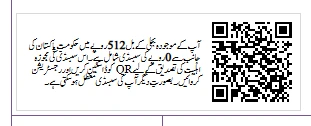
Your electricity bill may also contain a QR-style code similar to the example shown below. Consumers using 200 units or less can check whether they are eligible for the Government Electricity Subsidy Scheme. If you want to check your eligibility right now, click the banner below for complete details and step-by-step guidance.

14. Government Advertisement Section
Bills may include awareness messages such as:
Prime Minister Fan Replacement Program
This promotes energy-efficient appliances to reduce electricity bills.
Note: Advertisements do not affect billing.
15. Complaint & Helpline Information
At the bottom of the bill:
- 118 (Complaint Helpline)
- SMS 8118
- NEPRA Asaan Approach App
Use these for:
- Overbilling
- Wrong readings
- Service complaints
Final Summary
After reading this article you can:
- Understand charges
- Verify units
- Avoid penalties
- Detect errors early
This structure applies to almost all electricity bills in Pakistan, not just HAZECO.


Hous
House bill check
This is a very detailed and informative guide, it really helps in understanding every part of the electricity bill in a simple way. I appreciate the effort put into explaining even complex sections so clearly.