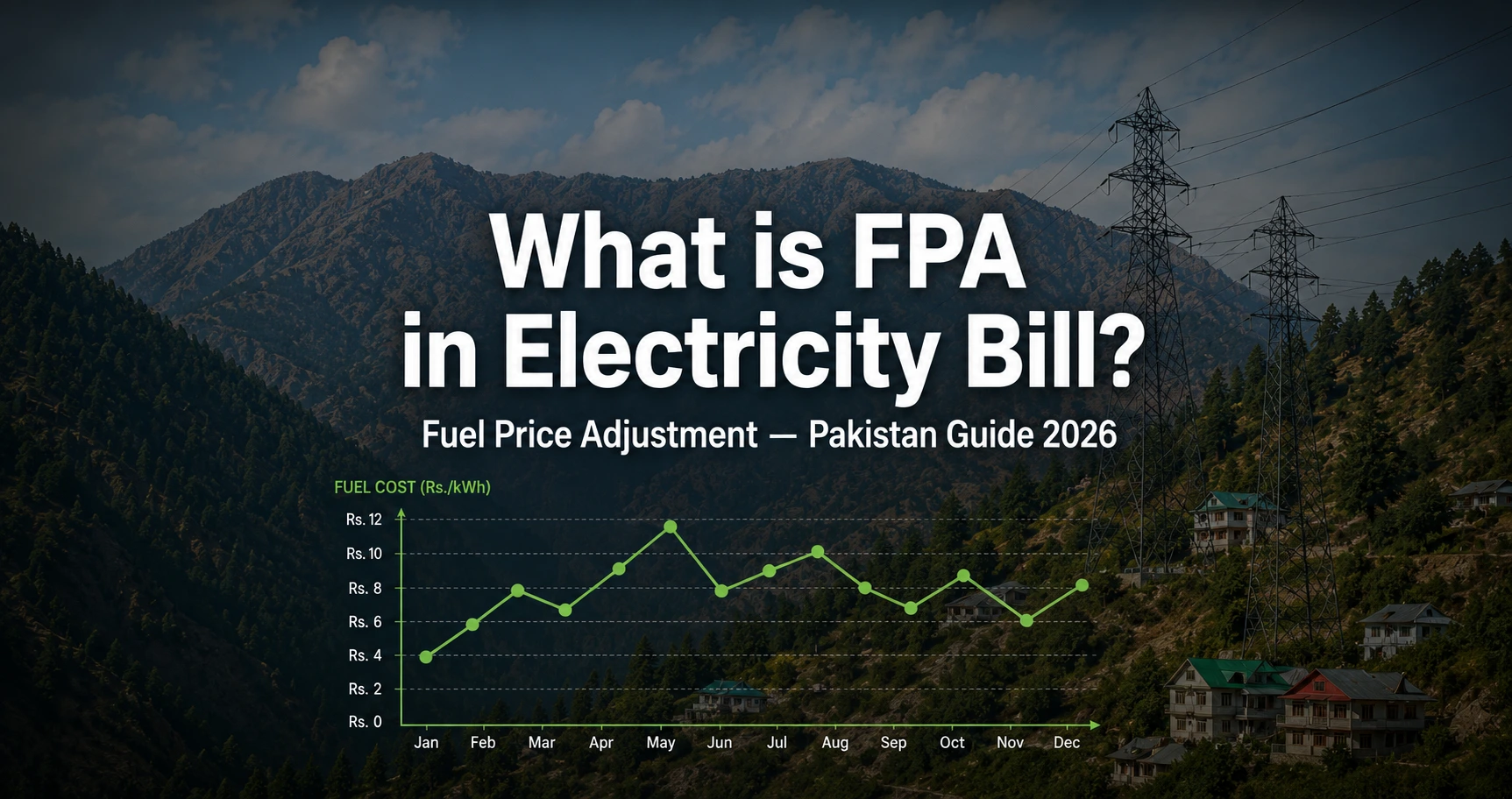
What is FPA in Electricity Bill? The Complete Pakistan Guide (2026)
If your electricity bill jumped this month but your usage barely changed, there is a good chance FPA is behind it. It is one of the most complained-about charges on Pakistani DISCOs’ electricity bills — and one of the least explained.
This guide covers what FPA actually is, how NEPRA calculates it, why it changes every month, what a negative FPA means for your wallet, how it differs from FC surcharge, and whether you have any legal grounds to dispute it. Real numbers, real bill examples, no filler.
What Does FPA Stand For?
FPA stands for Fuel Price Adjustment. It is a variable monthly charge on every Pakistani electricity bill that reflects the actual cost of fuel used to generate electricity during a specific period — compared to the cost that was assumed when NEPRA set the standard tariff.
Think of it this way: NEPRA fixes a base tariff using an estimated fuel cost. If actual fuel prices (gas, oil, LNG, coal) end up higher than that estimate, you pay the difference through FPA. If they come in lower, you get a credit — that is what a negative FPA looks like.
The key thing to understand is that FPA is not a fixed charge. It is not a penalty. It is not a tax. It is a cost pass-through mechanism — the difference between what was assumed and what was actually spent on fuel to generate the electricity you used.
How FPA Works in Pakistan’s Energy System
Pakistan generates electricity through a mix of sources — hydropower, gas-fired plants, oil-based power plants, coal plants, and LNG terminals. The fuel-based plants (which still produce a large portion of the national grid’s output) have running costs that move with global and domestic fuel prices.
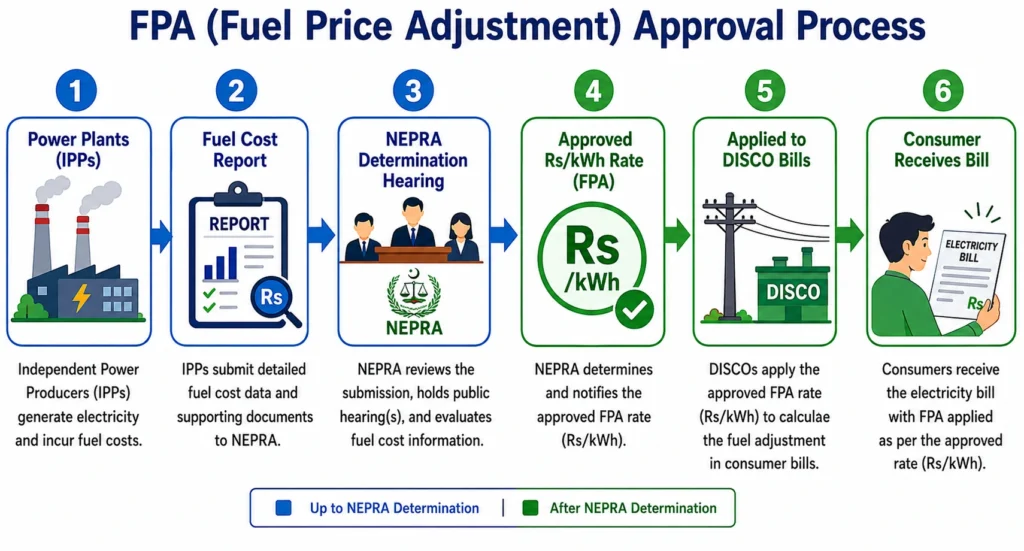
Here is the process from fuel cost to your bill:
Step 1 — Power plants report fuel costs. Every month, Independent Power Producers (IPPs) and public sector generation companies submit their actual fuel cost data to NEPRA.
Step 2 — NEPRA runs a determination. NEPRA reviews these costs against the reference fuel prices embedded in the existing tariff. The difference per kilowatt-hour becomes the FPA rate.
Step 3 — There is a 2 to 3 month lag. The FPA you see on your June bill is not for June. NEPRA needs time to collect data, hold a determination hearing, and formally notify DISCOs. In practice, the FPA charge on your bill today typically corresponds to fuel costs from 2 to 3 months earlier.
Step 4 — DISCOs apply it to your bill. Your DISCO (HAZECO, PESCO, IESCO, MEPCO, LESCO, FESCO, etc.) applies the approved FPA rate to your consumed units that month.
This lag is why you sometimes see a large FPA charge on your bill during a month when global oil prices seem stable — you are actually being charged for a period when prices were high several months ago.
How to Find FPA on Your Electricity Bill
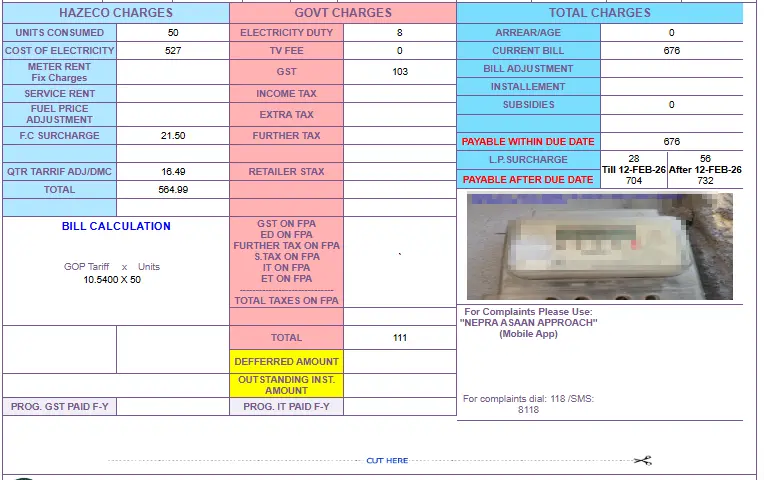
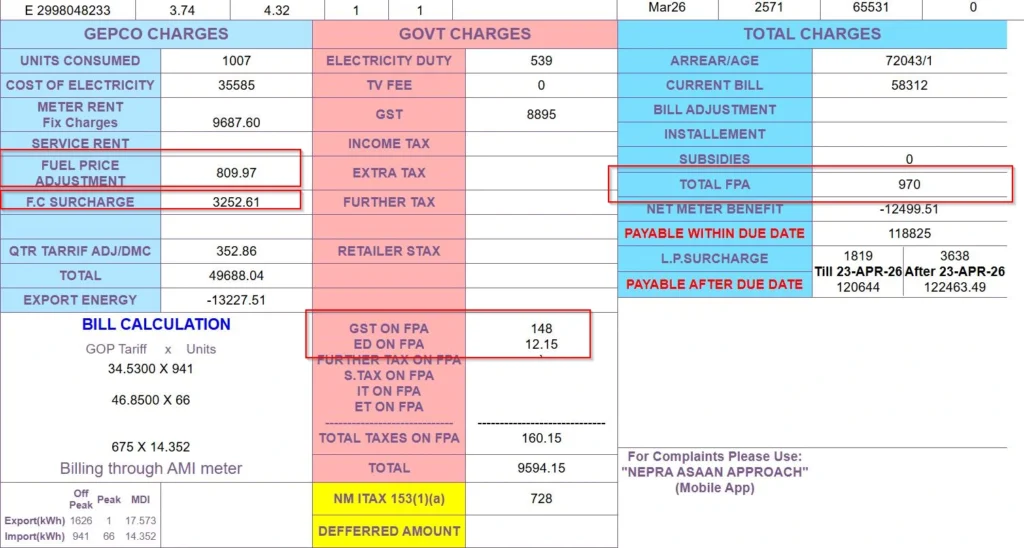
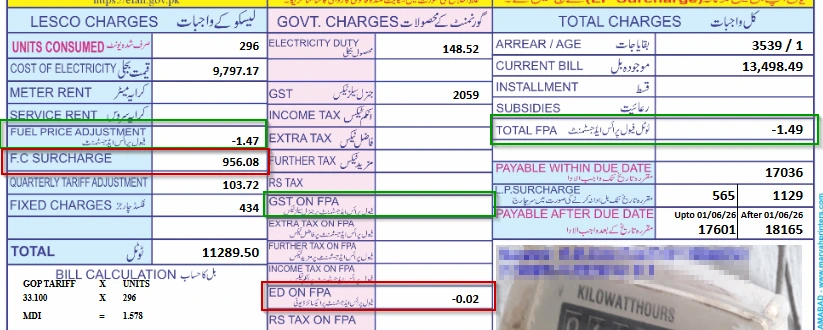
On a standard Pakistani electricity bill, FPA appears as a separate line item below the base tariff charge. Look for:
- “F.P.A.” or “Fuel Price Adj.” — the main FPA charge
- “GST on F.P.A.” — the 18% GST applied on top of the FPA amount
- “F.C. Surcharge” — a separate charge, often confused with FPA (explained below)
The FPA line will show a positive Rs. value when fuel costs were above the tariff reference price, and a negative Rs. value (appearing in brackets or with a minus sign) when fuel costs were below it.
How to Calculate FPA in Electricity Bill
The formula is straightforward:
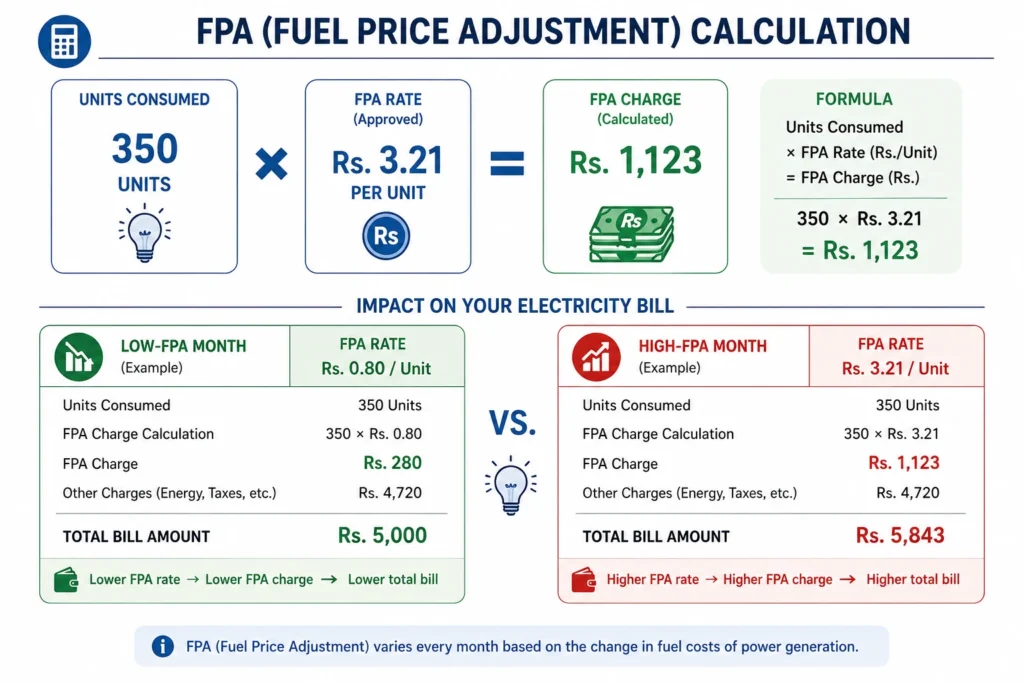
FPA Charge (Rs.) = Units Consumed (in NEPRA Specified Previous Month) × FPA Rate (Rs./kWh)
Worked example:
- Units consumed a specific month: 350 kWh
- NEPRA-approved FPA rate: Rs. 3.21 per unit
- FPA charge on your bill: 350 × 3.21 = Rs. 1,123.50
- GST on FPA (18%): Rs. 202.23
- Total FPA-related charge: Rs. 1,325.73
That amount sits on top of your regular tariff charges. In a month where the FPA rate is high, it can easily add Rs. 1,000–2,000 to a mid-sized household bill — which explains the shock consumers feel when usage stays flat but the total jumps.
Current FPA Rate Per Unit (Live — Updated Monthly)
This rate is sourced from NEPRA’s official monthly determination. We update it as soon as NEPRA publishes each month’s approved rate.
Use Our FPA Calculator
Enter your consumed units for Mar-26 and the system will calculate from the current FPA rate of -0.0102 Rs/kWh to give you exactly how much FPA is relief to your May-26 bill this month.
Enter your consumed units in {nepra specified month} and the system will calculate from {current FPA rate} to give you exactly how much FPA is adding to your bill this month.
Why Does FPA Change Every Month?
Three things drive the monthly movement in FPA:
1. Global fuel prices. Pakistan imports a significant portion of its LNG and furnace oil. When international commodity prices rise — due to supply disruptions, geopolitical events, or seasonal demand — the generation cost goes up, and FPA follows.
2. The energy mix that month. Hydropower is cheap and fuel-free. During monsoon season (July to September), hydro generation is high, which reduces the share of expensive fuel-based generation. FPA rates tend to be lower in those months. During winter or dry periods, more oil and gas plants run, pushing FPA up.
3. Exchange rate movement. Fuel imports are priced in US dollars. When the Pakistani rupee weakens, the same barrel of oil costs more in rupees — and that cost passes through to your FPA.
Historical FPA Rates in Pakistan (2012–2026)
Understanding where FPA has been helps you understand why your bills have moved the way they have.
| Billing Month | FPA Month | Rate (Rs/kWh) |
|---|---|---|
| Dec-26 | — | — |
| Nov-26 | — | — |
| Oct-26 | — | — |
| Sep-26 | — | — |
| Aug-26 | — | — |
| Jul-26 | — | — |
| Jun-26 | — | — |
| May-26 | — | — |
| Apr-26 | — | — |
| Mar-26 | Jan-26 | +1.6274 |
| Feb-26 | Dec-25 | +0.2841 |
| Jan-26 | Nov-25 | -0.9326 |
| Billing Month | FPA Month | Rate (Rs/kWh) |
|---|---|---|
| Dec-25 | Oct-25 | -0.8816 |
| Nov-25 | Sep-25 | -0.4812 |
| Oct-25 | Aug-25 | +0.0796 |
| Sep-25 | Jul-25 | -1.7856 |
| Aug-25 | Jun-25 | -0.6541 |
| Jul-25 | May-25 | -0.4952 |
| Jun-25 | Apr-25 | +0.9306 |
| May-25 | Mar-25 | -0.2883 |
| Apr-25 | Feb-25 | -0.4641 |
| Mar-25 | Jan-25 | -2.124 |
| Feb-25 | Dec-24 | -1.2283 |
| Jan-25 | Nov-24 | -0.7556 |
| Billing Month | FPA Month | Rate (Rs/kWh) |
|---|---|---|
| Dec-24 | Oct-24 | -1.1445 |
| Nov-24 | Sep-24 | -1.2754 |
| Oct-24 | Aug-24 | -0.8555 |
| Sep-24 | Jul-24 | -0.3692 |
| Aug-24 | Jun-24 | +2.5627 |
| Jul-24 | May-24 | +3.3287 |
| Jun-24 | Apr-24 | +3.3321 |
| May-24 | Mar-24 | +2.8372 |
| Apr-24 | Feb-24 | +4.9213 |
| Mar-24 | Jan-24 | +7.0562 |
| Feb-24 | Dec-23 | +4.5671 |
| Jan-24 | Nov-23 | +4.1276 |
| Billing Month | FPA Month | Rate (Rs/kWh) |
|---|---|---|
| Dec-23 | Oct-23 | +3.0786 |
| Nov-23 | Sep-23 | +0.4014 |
| Oct-23 | Aug-23 | +1.7141 |
| Sep-23 | Jul-23 | +1.463 |
| Aug-23 | Jun-23 | +1.81 |
| Jul-23 | May-23 | +1.9039 |
| Jun-23 | Apr-23 | +1.6075 |
| May-23 | Mar-23 | +0.7917 |
| Apr-23 | Feb-23 | -0.0006 |
| Mar-23 | Jan-23 | +0.4779 |
| Feb-23 | Dec-22 | -2.3166 |
| Jan-23 | Nov-22 | +0.1892 |
| Billing Month | FPA Month | Rate (Rs/kWh) |
|---|---|---|
| Dec-22 | Oct-22 | -0.3213 |
| Nov-22 | Sep-22 | +0.0819 |
| Oct-22 | Aug-22 | +0.1918 |
| Sep-22 | Jul-22 | +4.3435 |
| Aug-22 | Jun-22 | +9.8972 |
| Jul-22 | May-22 | +7.904 |
| Jun-22 | Apr-22 | +3.9923 |
| May-22 | Mar-22 | +2.868 |
| Apr-22 | Feb-22 | +4.853 |
| Mar-22 | Jan-22 | +5.949 |
| Feb-22 | Dec-21 | +3.0968 |
| Jan-22 | Nov-21 | +4.302 |
| Billing Month | FPA Month | Rate (Rs/kWh) |
|---|---|---|
| Dec-21 | Oct-21 | +4.7446 |
| Nov-21 | Sep-21 | +2.5272 |
| Oct-21 | Aug-21 | +1.9539 |
| Sep-21 | Jul-21 | +1.3771 |
| Aug-21 | Jun-21 | -0.193 |
| Jul-21 | May-21 | -0.2644 |
| Jun-21 | Apr-21 | -0.4371 |
| May-21 | Mar-21 | -0.6434 |
| Apr-21 | Feb-21 | +0.6416 |
| Mar-21 | Jan-21 | +0.8954 |
| Feb-21 | Dec-20 | +1.5359 |
| Jan-21 | Nov-20 | +0.7696 |
| Billing Month | FPA Month | Rate (Rs/kWh) |
|---|---|---|
| Dec-20 | Sep-20 | +1.1138 |
| Nov-20 | Aug-20 | +0.4828 |
| Oct-20 | Jul-20 | +0.8376 |
| Sep-20 | Jun-20 | -1.0581 |
| Aug-20 | May-20 | -1.2517 |
| Jul-20 | — | — |
| Jun-20 | — | — |
| May-20 | — | — |
| Apr-20 | — | — |
| Mar-20 | — | — |
| Feb-20 | — | — |
| Jan-20 | Oct-19 | +1.5656 |
| Billing Month | FPA Month | Rate (Rs/kWh) |
|---|---|---|
| Dec-19 | Sep-19 | +1.8266 |
| Nov-19 | Aug-19 | +1.6615 |
| Oct-19 | Jul-19 | +1.7799 |
| Sep-19 | — | — |
| Aug-19 | — | — |
| Jul-19 | May-19 | +0.0999 |
| Jun-19 | Apr-19 | +0.5508 |
| May-19 | Mar-19 | -0.0372 |
| Apr-19 | Feb-19 | +0.809 |
| Mar-19 | Jan-19 | +1.8056 |
| Feb-19 | Dec-18 | +0.5685 |
| Jan-19 | Nov-18 | -0.3228 |
| Billing Month | FPA Month | Rate (Rs/kWh) |
|---|---|---|
| Dec-18 | Oct-18 | +0.4741 |
| Nov-18 | Sep-18 | +0.1999 |
| Oct-18 | Aug-18 | +1.1635 |
| Sep-18 | Jul-18 | +0.3525 |
| Aug-18 | Jun-18 | +0.5084 |
| Jul-18 | May-18 | +1.2212 |
| Jun-18 | Apr-18 | -0.6898 |
| May-18 | Mar-18 | -1.8851 |
| Apr-18 | Feb-18 | -2.2866 |
| Mar-18 | Jan-18 | -3.2421 |
| Feb-18 | Dec-17 | -2.9844 |
| Jan-18 | Nov-17 | -3.1143 |
| Billing Month | FPA Month | Rate (Rs/kWh) |
|---|---|---|
| Dec-17 | Oct-17 | -2.2548 |
| Nov-17 | Sep-17 | -2.1941 |
| Oct-17 | Aug-17 | -1.8198 |
| Sep-17 | Jul-17 | -1.7094 |
| Aug-17 | Jun-17 | -2.2359 |
| Jul-17 | May-17 | -1.7522 |
| Jun-17 | Apr-17 | -1.9624 |
| May-17 | Mar-17 | -2.1484 |
| Apr-17 | — | — |
| Mar-17 | Jan-17 | -3.3086 |
| Feb-17 | Dec-16 | -2.2195 |
| Jan-17 | Nov-16 | -3.6084 |
| Billing Month | FPA Month | Rate (Rs/kWh) |
|---|---|---|
| Dec-16 | Oct-16 | -2.6096 |
| Nov-16 | Sep-16 | -2.7734 |
| Oct-16 | Aug-16 | -2.5648 |
| Sep-16 | Jul-16 | -2.4934 |
| Aug-16 | Jun-16 | -2.8 |
| Jul-16 | May-16 | -3.3218 |
| Jun-16 | Apr-16 | -3.9413 |
| May-16 | Mar-16 | -2.8373 |
| Apr-16 | Feb-16 | -4.3646 |
| Mar-16 | Jan-16 | -4.0434 |
| Feb-16 | Dec-15 | -3.8361 |
| Jan-16 | Nov-15 | -2.0657 |
| Billing Month | FPA Month | Rate (Rs/kWh) |
|---|---|---|
| Dec-15 | Oct-15 | -1.8147 |
| Nov-15 | Sep-15 | -2.88 |
| Oct-15 | Jul-15 | -2.1374 |
| Sep-15 | May-15 | -2.6872 |
| Aug-15 | Apr-15 | -1.8613 |
| Jul-15 | Mar-15 | -3.6197 |
| Jun-15 | — | — |
| May-15 | Feb-15 | -4.426 |
| Apr-15 | Jan-15 | -2.0841 |
| Mar-15 | Dec-14 | -3.2426 |
| Feb-15 | — | — |
| Jan-15 | Nov-14 | -2.9672 |
| Billing Month | FPA Month | Rate (Rs/kWh) |
|---|---|---|
| Dec-14 | Oct-14 | -0.4795 |
| Nov-14 | Sep-14 | +0.5171 |
| Oct-14 | — | — |
| Sep-14 | Jul-14 | +0.4331 |
| Aug-14 | — | — |
| Jul-14 | — | — |
| Jun-14 | — | — |
| May-14 | — | — |
| Apr-14 | — | — |
| Mar-14 | — | — |
| Feb-14 | — | — |
| Jan-14 | Jan-14 | +2.2424 |
| Billing Month | FPA Month | Rate (Rs/kWh) |
|---|---|---|
| Dec-13 | — | — |
| Nov-13 | Sep-13 | +0.3229 |
| Oct-13 | — | — |
| Sep-13 | Jul-13 | -0.2977 |
| Aug-13 | — | — |
| Jul-13 | — | — |
| Jun-13 | Nov-12 | +0.9128 |
| May-13 | — | — |
| Apr-13 | — | — |
| Mar-13 | — | — |
| Feb-13 | Jul-12 | +0.852 |
| Jan-13 | Jun-12 | +0.2333 |
| Billing Month | FPA Month | Rate (Rs/kWh) |
|---|---|---|
| Dec-12 | May-12 | +1.5096 |
| Nov-12 | — | — |
| Oct-12 | — | — |
| Sep-12 | Feb-12 | +0.5885 |
| Aug-12 | — | — |
| Jul-12 | — | — |
| Jun-12 | — | — |
| May-12 | — | — |
| Apr-12 | Sep-11 | +2.22 |
| Mar-12 | Aug-11 | +3.033 |
| Feb-12 | Jul-11 | +2.45 |
| Jan-12 | Jun-11 | +3.33 |
- Fuel Price Adjustment (FPA) is determined by NEPRA on a monthly basis.
- Rates can be positive (additional charges) or negative (relief for consumers).
Source: NEPRA monthly FPA determinations.
Notice the pattern: summer months (June, July, August) tend to carry higher FPA because peak cooling demand forces more thermal generation. Monsoon relief and a stronger rupee bring it down in autumn.
What is Negative FPA? Can It Save You Money?
Yes — FPA can go negative, and when it does, it works in your favour.
A negative FPA appears when the actual fuel cost used to generate electricity came in below the reference price built into your tariff. NEPRA then mandates that DISCOs pass this saving back to consumers as a deduction on the bill.
On your bill it looks like a negative Rs. value on the FPA line, or it may appear in brackets — effectively reducing your total payable amount.
Pakistan saw negative FPA in certain months of 2023 when hydro generation was exceptionally high and LNG spot prices softened. For a 300-unit household, a negative FPA of Rs. −2.50/unit would have meant a Rs. 750 reduction on that month’s bill.
Negative FPA does not carry forward automatically — each month is its own determination. If you think your bill shows an incorrect FPA value (positive or negative), the dispute process is covered below.
FPA vs FC Surcharge — What is the Difference?
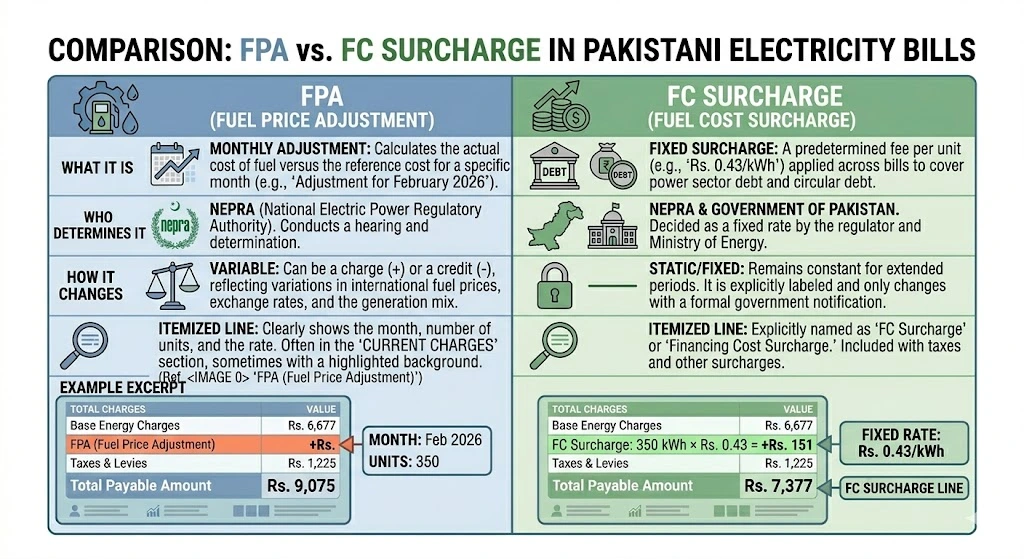
These two charges confuse almost everyone because they appear next to each other on the bill and both relate to fuel. They are not the same thing.
| FPA (Fuel Price Adjustment) | FC Surcharge (Fuel Cost Surcharge) | |
|---|---|---|
| What it is | Monthly adjustment for actual vs reference fuel cost | Fixed surcharge to fund past energy-sector debt |
| Set by | NEPRA — changes monthly | Government — relatively fixed |
| Direction | Can be positive or negative | Always positive |
| Legal basis | NEPRA Act, Section 31 | Finance Act / government notification |
| Rate behaviour | Varies every month | Fixed until government revises it |
The short version: FPA varies with market conditions. FC surcharge is a fixed levy that funds the circular debt settlement and energy-sector borrowing costs. Both appear on your bill; only FPA moves up and down month to month.
GST on FPA — The Tax on a Tax
Once FPA is calculated, 18% GST is applied on top of it. This is a common source of frustration — consumers are paying tax on what is already an adjustment charge.
Using the earlier example:
- FPA charge: Rs. 1,123.50
- GST at 18%: Rs. 202.23
- Combined FPA-related total: Rs. 1,325.73
GST on FPA is a federal levy and appears as a separate line on your bill. When FPA is negative, GST on FPA also becomes negative — so a credit month reduces your tax burden too.
FPA for Protected Consumers (0–200 Units)
Consumers using 200 units or fewer per month are classified as “protected consumers” under NEPRA’s tariff structure and receive a subsidised base rate.
Within the protected category, consumers using 100 units or fewer per month fall under the Lifeline subcategory. Lifeline consumers receive a more heavily subsidised base rate than standard protected consumers. However, like all other categories, the FPA rate that applies to them is set uniformly by NEPRA — so the Lifeline subsidy covers the base tariff only, not the FPA component of the bill.
FPA is set by NEPRA at a uniform rate per unit and applies to all consumer categories including protected consumers. The subsidy that protected consumers receive applies to their base tariff slab — not to FPA. So while a protected consumer pays less per unit on their base charge, the FPA rate on their bill is the same as everyone else’s.
If you are a protected consumer and FPA is appearing at the full commercial rate on your bill, that is worth raising with your DISCO — it may be a classification error.
FPA and Solar Prosumers — 2026 Policy Update
Pakistan’s billing structure for solar consumers changed dramatically in February 2026. Here’s the current status:
If you are an existing prosumer (registered before February 9, 2026):
Your contract terms remain protected. You will continue to benefit from the previous net metering rates and unit-for-unit adjustment system until your agreement expires. FPA is applied only to your net imported units — this mechanism remains unchanged for you. One important condition: if you materially upgrade your solar system capacity, these grandfathered benefits will end.
If you are a new prosumer (applying after February 9, 2026):
You fall under the Prosumer Regulations 2026 and the new net billing system. Your solar generation will be purchased by the DISCO at the NAEPP rate of Rs. 8.13 per unit, while electricity taken from the grid will be charged at the applicable tariff (around Rs. 40–50 per unit). FPA is applied on all units imported from the grid — since there is no unit-for-unit offset under net billing, every unit you draw from the grid is subject to the applicable tariff and FPA.
Bottom line regarding FPA:
In both cases, FPA is charged only on units imported from the grid — not on what your solar panels generate. The difference is how ‘net’ is defined: for existing prosumers, solar offsets grid units one-for-one before FPA is applied. For new prosumers, there is no offset — your solar generation is sold separately at Rs. 8.13/unit, and FPA applies to every grid unit you import.
Is FPA Different Across DISCOs?
The FPA rate per unit is set nationally by NEPRA and applies uniformly across all DISCOs — MEPCO, LESCO, FESCO, IESCO, HESCO, PESCO, SEPCO, QESCO, TESCO, and HAZECO.
What does differ across DISCOs is:
- The accuracy of meter readings. An estimated bill (where actual consumption was not read) can result in an incorrectly calculated FPA if units are wrong.
- Billing cycle timing. Some DISCOs issue bills a few days earlier or later, which can mean an FPA determination that was just published gets applied in the following cycle rather than the current one.
- Protected consumer classification. Not all DISCOs are equally accurate in maintaining updated consumer category data. A consumer who should be classified as protected may be billed at the unprotected FPA rate due to a records error.
- K-Electric billing timeline. K-Electric operates under a separate regulatory framework from ex-WAPDA DISCOs and is billed directly by NEPRA rather than through the standard DISCO channel. This means the FPA determination timing for K-Electric consumers can occasionally differ by a billing cycle from what ex-WAPDA consumers see in the same month.
The Lahore High Court FPA Ruling — What It Means for You
In 2023, the Lahore High Court ruled that FPA lacked proper statutory foundation under the NEPRA Act and could not be included in electricity bills as then structured. This received significant attention among consumer-rights circles.
However, the LHC ruling did not stand. In October 2023, the Supreme Court overturned it, declaring the LHC decision “impractical both constitutionally and legally.” The Supreme Court held that technical matters involving NEPRA fall under the NEPRA Appellate Tribunal’s jurisdiction — not the high court — and directed petitioners to pursue the matter there instead.
FPA collection by DISCOs continued uninterrupted throughout this period and remains in force today.
What you can do: If you believe FPA was charged incorrectly in a specific billing period, the proper channel is the NEPRA Appellate Tribunal, not the high court. You can also file a complaint with NEPRA’s Consumer Services at 0800-63772 (toll-free) or via nepra.org.pk for billing errors such as wrong consumer category or incorrect rate application.
Can You Dispute an FPA Charge?
You can — and in some cases you should. Here are the legitimate grounds for disputing an FPA charge on your electricity bill:
1. Your consumer category is wrong. If you should be classified as a protected consumer (0–200 units) but FPA was charged at the unprotected rate, file a complaint with your DISCO’s consumer services centre.
2. Your units were estimated, not read. If your bill shows “estimated reading” and the unit count is wrong, the FPA will also be wrong. Request a meter inspection and re-billing.
3. An incorrect rate was applied. The NEPRA-approved FPA rate is public. If the rate on your bill does not match the official NEPRA determination for that month, that is a billing error.
4. You want to challenge the charge on legal grounds. The proper forum is the NEPRA Appellate Tribunal. You can also file a complaint with NEPRA’s Consumer Services department at:
- NEPRA Consumer Services: 0800-63772 (toll-free)
- Online complaint portal: nepra.org.pk
- Your DISCO’s complaint centre (MEPCO: 118, LESCO: 118, etc.)
Document your complaint in writing and keep a copy of the bill in question. NEPRA is required by law to respond within a defined period.
FAQs
Can FPA be negative on my electricity bill?
Yes. When actual fuel costs come in below NEPRA’s reference price, FPA is negative and appears as a deduction on your bill. It reduces your total payable amount for that month.
Why is FPA on my bill from 2 months ago?
Because there is a processing lag between when fuel is consumed by power plants, when DISCOs report costs to NEPRA, and when NEPRA formally approves a rate. The FPA you pay today reflects fuel costs from roughly 2 to 3 months earlier.
Is FPA the same as fuel adjustment charge?
Yes — “fuel adjustment charge” and “fuel price adjustment” refer to the same thing. Some DISCOs abbreviate it differently on bill printouts but it is the same NEPRA-approved line item.
Why is my FPA different from my neighbour’s?
If you consumed different numbers of units, your FPA will differ because the charge is per-unit. The rate per unit is the same — only the total differs based on consumption.
Does FPA apply to commercial and industrial consumers?
Yes. The FPA rate per unit is the same across all consumer categories. However, commercial and industrial consumers consume significantly more units, so their total FPA charge is substantially higher.
What is GST on FPA and can it be waived?
GST on FPA is a 18% federal tax applied to the FPA charge. It cannot be waived for most consumers as it is a standard tax levy. It goes negative when FPA is negative.
Can I reduce my FPA charges?
The rate is set by NEPRA and you cannot negotiate it. But since FPA is calculated per unit, consuming less electricity directly reduces your FPA exposure. Shifting to solar reduces your net imported units, which is currently the most effective way to reduce FPA on a structural basis.
Is FPA the same across LESCO, MEPCO, FESCO and other DISCOs?
The rate per unit is set by NEPRA for the whole country and is the same across all DISCOs. Your total FPA charge differs only because your unit consumption differs.
Final Words
FPA is not an arbitrary charge. It is a real cost — the difference between what Pakistan’s power plants actually spent on fuel and what NEPRA estimated when setting the tariff. When oil prices spike, rupee weakens, or hydro output drops, that gap widens and your bill reflects it.
The parts that are legitimately worth questioning: whether your consumer category is correct, and whether your meter is being read accurately.
The best practical protection for most households is to monitor your units closely, verify your consumer category with your DISCO, and consider solar if you are a heavy user — since FPA is calculated on net imported units.
Last reviewed: May 2026 | Sources: NEPRA monthly determinations, DISCO billing guidelines, Supreme Court judgment dated October 16, 2023 (FPA ruling).
Author bio: [HAZECO Bill Team], a Pakistan-based resource covering electricity billing, tariffs, and consumer rights for residential and commercial consumers.